
Ten
Minutes
You have ten minutes. What do you take, and who are you forgetting?
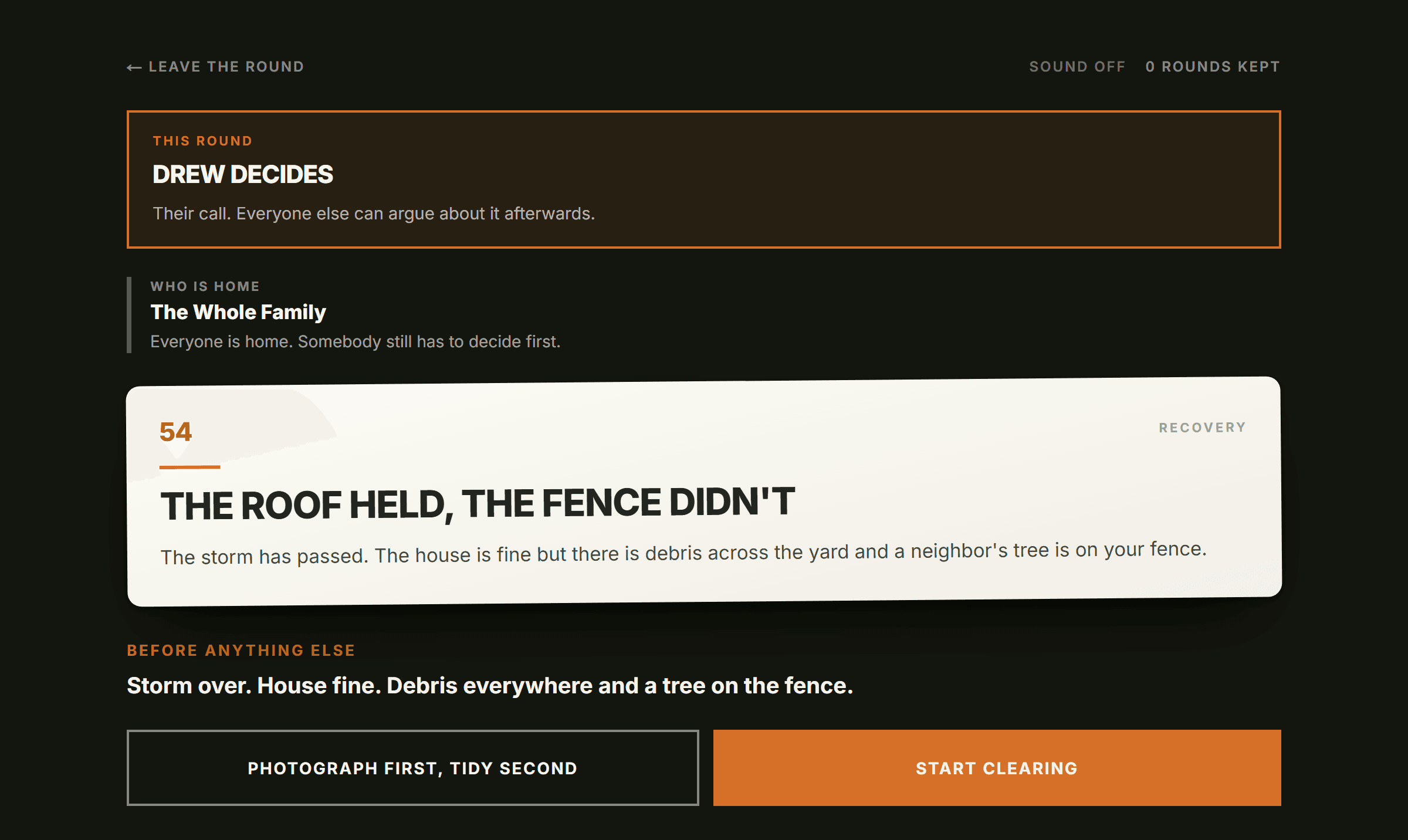
Draw a real situation. Decide what your household actually does — and find out what that decision costs. What you type becomes a printable S.A.F.E. plan for your house, and the game shows you the gaps you did not know you had.
All 92 cards · no account · nothing to install
We never see your answers. Scores and notes stay in your own browser — no account, and the play screens carry no advertising trackers at all. The one exception is an invitation you choose to send: that carries the name and email of the person you invite, your household name and the role — never a card, an answer or a score.
You only score for answers you can prove
This is the whole design, and it is what separates the game from a conversation you have already had and forgotten.
Three rounds averaging four points earns your household Level 1 of the Outpost Standard — and Level 1 is as far as the game goes, on purpose. Levels 2 and 3 are claims about what you physically have and can do, so they need evidence rather than a score. Here’s why.
Nobody gets hurt in this game
Not one card in the deck injures a person, harms a pet, or describes anything happening to anybody. The tension is always a decision under a clock. That is a design rule, not a tone of voice, and it is why a seven-year-old can play it without being frightened of their own house.
Anyone can pass
If a card lands badly, it goes back and you draw another. No explanation, no discussion.
“I don’t know” wins
It is not a failure. It is the most useful thing you will learn all evening, and it becomes your list.
Nobody loses
The household scores, not the person. Helping is the skill being practised.
What you get
A decision on every card
Every card poses the choice it actually poses — out now or check it first, believe the radio or the faster source, act today or tomorrow. Get it wrong and it costs you minutes off your ten.
60 scenarios, 24 curveballs
Weighted to what households actually meet — outages and storms far more than hurricanes. A curveball lands mid-round, every round, whether you want it or not.
Your S.A.F.E. plan, written as you play
The answers you type fill in a real household emergency plan beside you — rally points, out-of-state contact, what would make you leave. Printable, and it never leaves your browser.
Cards that fit your actual house
A household of one is never dealt “the kids are in charge”. Tell it who lives there once and the deck adapts for good.
The round, played back
At the end you get the story of what your answers meant, written from your own words — and the single gap that cost you most.
Your circle
Name the people your plan depends on. Each gets one question and can say yes or no, so you find out who has actually agreed before you need them.
8 role cards
Who is home when it happens — including one where the children act first, because the plan has to work without you.
A record that ages honestly
Scores question by question against the first time you played — and it tells you when a confirmation has gone stale, because readiness does.
It comes free with the Go-Bag
Every kit ships with the whole digital vault, and this is in it. The game is free while it is in beta — a bag nobody has rehearsed with is a receipt, so we would rather you played first and bought second.