
Go-bag vs. bug-out bag vs. 72-hour kit: what the names mean, and which one you actually need
Go-bag, bug-out bag, BOB, 72-hour kit, get-home bag, vehicle kit, shelter-in-place kit. Some of those are the same thing wearing a different name. Some are genuinely different jobs. Here is the decoder, the side-by-side comparison, what belongs in each — and what the actual standards say, because none of them is 72 hours.
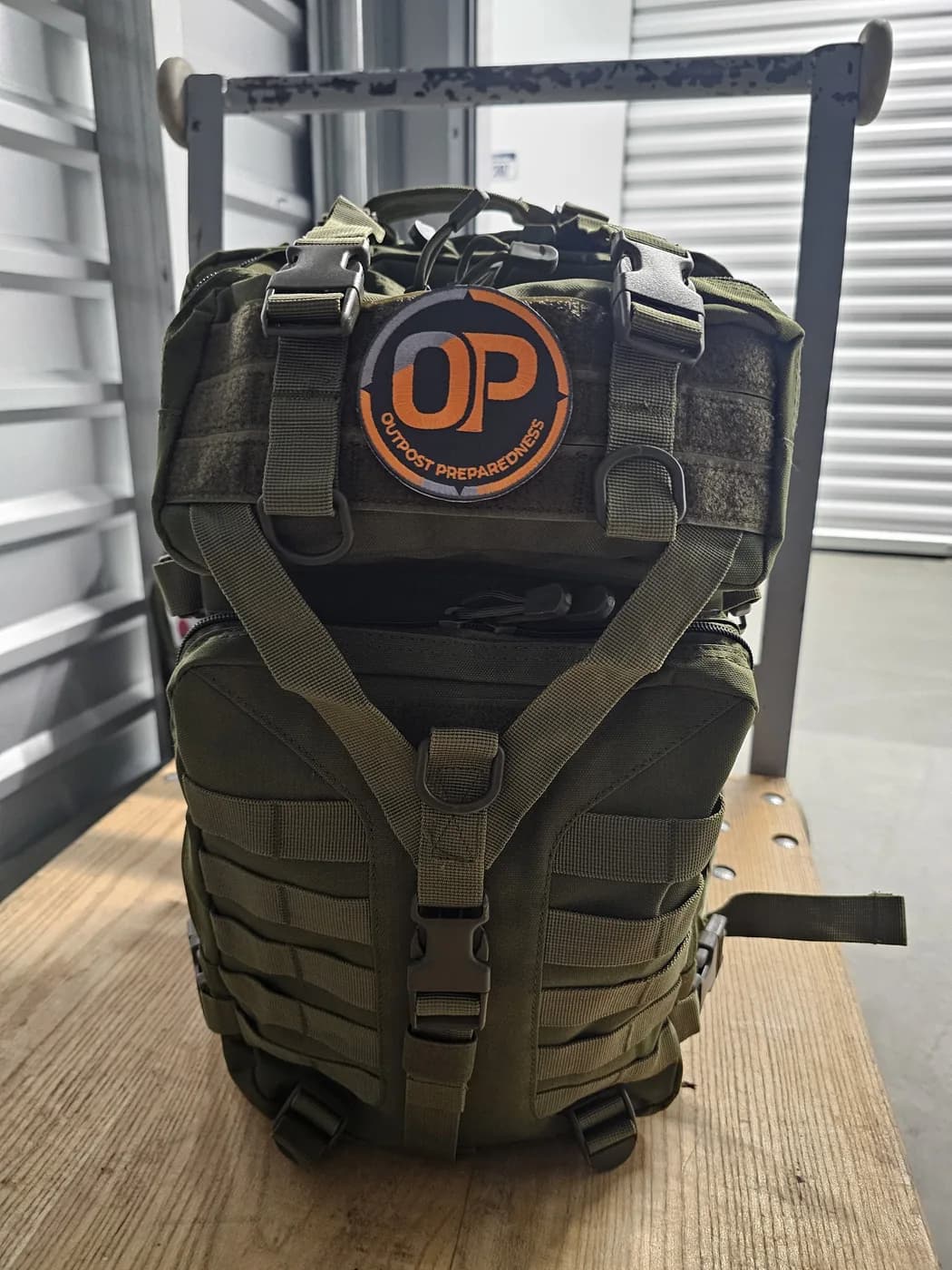
A go-bag and a bug-out bag are the same thing: a portable kit you grab on the way out the door, sized to keep one person going for about 72 hours. A "72-hour kit" is that same bag with the duration in the name. The kits that are genuinely different are different because they answer a different question, not because they hold different gear: a vehicle kit assumes you are stuck with your car, a get-home bag assumes you are at work and the trip home just got long, a shelter-in-place kit assumes you are staying put with the utilities out, and a facility kit assumes you are responsible for a building full of people who did not pack for themselves. Most households need two of these — one go-bag per person, and a shelter-in-place supply at home. A vehicle kit is the cheapest third.
First, the decoder: most of these names describe the same bag
The single biggest reason people end up with the wrong kit is that the category has about nine names and no referee. Someone reads a checklist for a "bug-out bag," buys one, and thinks they are done — when the gap in their life was actually a pair of walking shoes at the office.
So before comparing anything, it helps to separate the names that are synonyms from the names that describe a genuinely different job. "Bug out" is military-derived. "GOOD bag" is prepper shorthand for Get Out Of Dodge. "Grab bag" is what most of the UK and New Zealand call it. "Jump bag" is an EMS term and is not a personal kit at all. And the federal government does not use any of them — Ready.gov calls the home supply a "disaster supplies kit."
Here is the whole vocabulary in one place.
| Name you will hear | What it actually means | Same as a go-bag? |
|---|---|---|
| Go-bag | A portable kit grabbed on the way out the door | — |
| Bug-out bag (BOB) | Identical idea, military-derived name | Yes |
| 72-hour kit | A go-bag with the planning duration in the name | Yes |
| GOOD bag | "Get Out Of Dodge" — prepper shorthand | Yes |
| Grab bag / ready bag | Common outside the US, same contents | Yes |
| Evacuation bag | Same bag, named for the event instead of the act | Yes |
| Disaster supplies kit | Ready.gov's term — usually means the home supply | No — bigger, stays home |
| Get-home bag | Covers the trip from work back to your family | No — shorter, different contents |
| Vehicle / car kit | Lives in the trunk; you are stranded, not evacuating | No — different failure |
| Shelter-in-place kit | Supplies for staying put with utilities down | No — not portable |
| INCH bag | "I'm Never Coming Home" — indefinite self-sufficiency | No — far larger |
| Jump bag | An EMS responder's medical bag | No — professional gear |
Five kits, five different questions
Strip the names away and there are really only five kits, separated by the question each one answers. Not by what is inside them — the contents overlap heavily — but by where the kit lives and how long it has to hold.
That distinction matters more than any packing list, because a kit stored in the wrong place is not a kit. It is inventory.
| Kit | The question it answers | Where it lives | Plan for | One per |
|---|---|---|---|---|
| Go-bag | "We have to leave in ten minutes." | By the door you actually use | 72 hours | Person |
| Get-home bag | "I'm 22 miles from home and nothing is moving." | Desk, locker, or office drawer | 12–24 hours | Commuter |
| Vehicle kit | "I'm stuck with the car." | The trunk, permanently | 24–72 hours | Vehicle |
| Shelter-in-place kit | "We're staying, and nothing works." | Garage or closet shelf at home | A week or more | Household |
| Facility kit | "There are 300 people in this building." | Staged where staff can reach it | 72 hours | Site |
The go-bag: the one everybody means
This is the default. One bag, one person, packed for roughly three days away from home with no assumption that stores, power, or water are working.
Seventy-two hours is a convention, not a standard — and it is worth knowing that the federal guidance everyone is loosely quoting does not actually say it. Ready.gov tells households to be able to survive on their own "for several days." The number 72 appears nowhere on its Build A Kit page. Where hard numbers do exist, in the rules that bind hospitals and care homes and workplaces, none of them is 72 either. The next section lays them side by side.
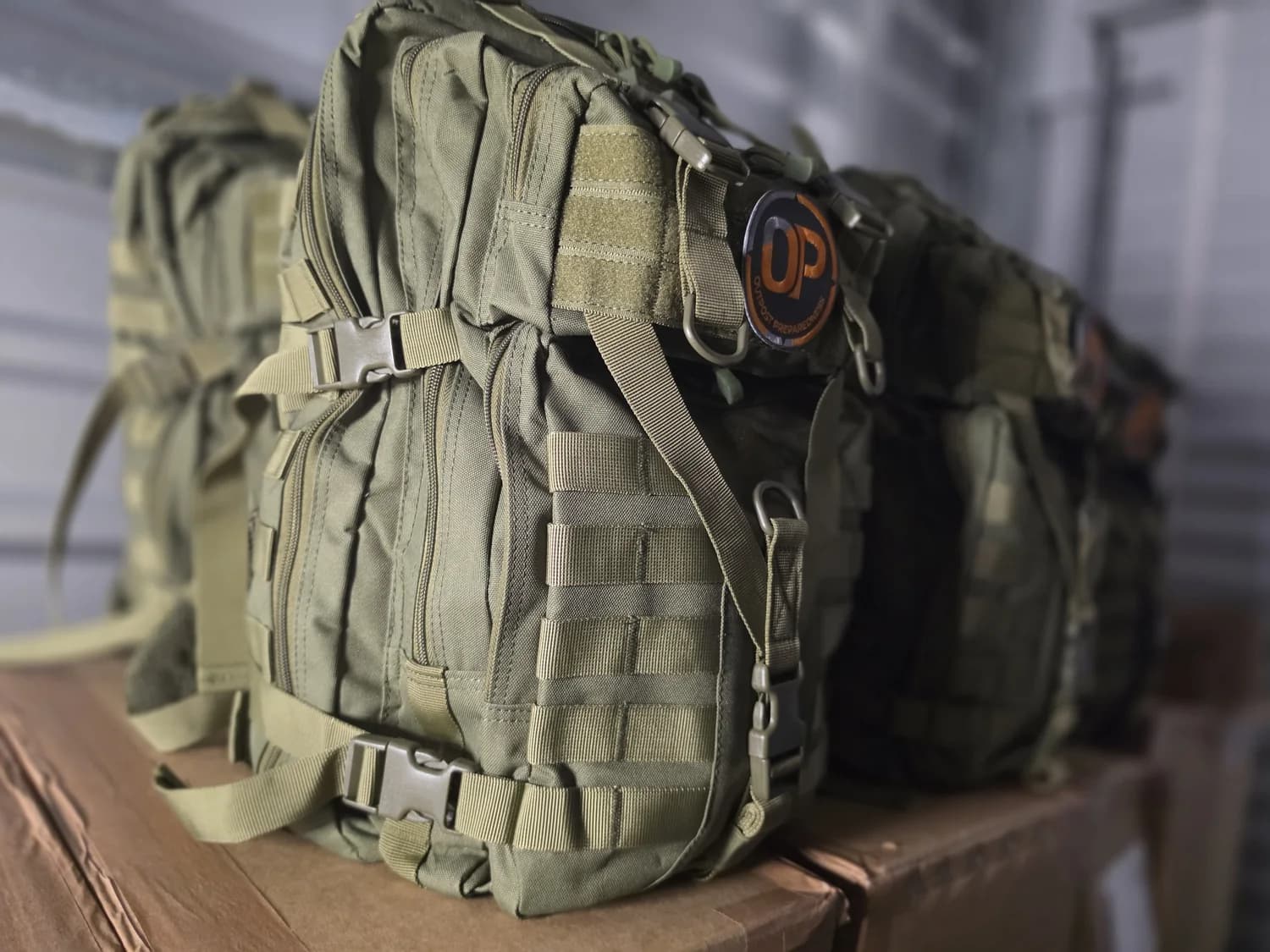
The constraint that actually governs a go-bag is weight, not capability. A bag you will not carry is a bag you will leave on the porch. The honest test is whether the person it belongs to can carry it up a flight of stairs without stopping — which means kids carry their own, sized down, and it means the temptation to add one more useful thing has to lose most arguments.
And the part people skip: where it lives beats what is in it. A perfect kit in the garage behind the holiday boxes is not a go-bag. It goes by the door you actually leave by, at the height you can grab it at in the dark, with shoes next to it.
Where "72 hours" actually comes from — and what the real standards say
The 72-hour figure is genuinely useful. It is a sane planning floor, it is short enough that people will actually do it, and it is the reason the category has a name. But it is a convention that hardened through repetition, not a number any federal household guidance issues.
Ready.gov's Build A Kit page says you may need to "survive on your own for several days," and specifies one gallon of water per person per day for several days, for drinking and sanitation. That is the whole federal quantity. Meanwhile every place a real duration is written into a rule lands somewhere other than 72 hours — and if you are buying for a building, those are the numbers that actually govern you.
Two things fall out of that table. First, if you are a household, 72 hours is a floor to clear and not a target to stop at; the states that have modelled their own worst case, like Oregon after studying a Cascadia earthquake, tell residents to plan for two weeks. Second, if you are an operator, the 96-hour rule is the most misread requirement in the category — it obliges you to assess and plan for 96 hours, not to warehouse 96 hours of supplies.
| Who it applies to | The number | What is actually required |
|---|---|---|
| Households — Ready.gov (federal) | "Several days" | One gallon of water per person per day for several days, drinking and sanitation. The page never says 72 hours. |
| Households — Oregon Dept. of Emergency Management | 2 weeks | The "Be 2 Weeks Ready" program: 14 days of food, water and supplies for each person and pet. |
| Hospitals — Joint Commission / CMS | 96 hours | Assess and plan for 96 hours of self-sustainment, and identify the gaps. Explicitly NOT a mandate to stockpile 96 hours or stay fully operational. |
| California RCFEs — 22 CCR §87555 | 1 week of food | Non-perishable food for a minimum of one week and perishable food for a minimum of two days, kept on the premises. |
| Workplaces — OSHA 29 CFR 1910.38 | No number | An Emergency Action Plan is required — reporting, evacuation, headcount, rescue duties. Supplies are not required at all. |
The vehicle kit: you are not walking, you are stuck
The vehicle kit gets treated as a smaller go-bag, and that is the wrong model. The go-bag assumes you are leaving. The vehicle kit assumes the car is where the problem found you — a closed highway, a breakdown on a rural road, a snowstorm that turns a 40-minute drive into nine hours in a stationary line of traffic.
So the contents diverge in a specific direction: toward the vehicle and toward temperature. Jumper cables or a lithium jump pack. A reflective triangle or flares. A tow strap. In cold country, an ice scraper and a bag of sand or cat litter for traction. A real blanket, not an emergency foil sheet. A 12V charger, because your phone is your only line out. Heat and cold are what actually hurt people in stranded-vehicle incidents — not hunger.
There is also an overlap worth naming honestly. For most Americans, evacuation is a drive, not a walk. Wildfire and hurricane evacuations happen in cars. That makes the trunk kit the one that is already with you when you do not get your ten minutes — which is an argument for keeping the vehicle kit a little richer than a pure roadside kit.
One caveat specific to this kit: a trunk in summer is an oven. Medications, batteries, sunscreen, and anything in a sealed pouch degrade faster there than on a shelf. Rotate the vehicle kit more often than the others, and do not use it to store the prescriptions you are counting on.
The get-home bag: the gap almost nobody fills
Nearly every household preparedness plan quietly assumes the family is together when it starts. On a weekday morning, that assumption is false for most people. The kids are at school, one parent is 20 miles one way, the other is somewhere else, and the event does not wait for a convenient hour.
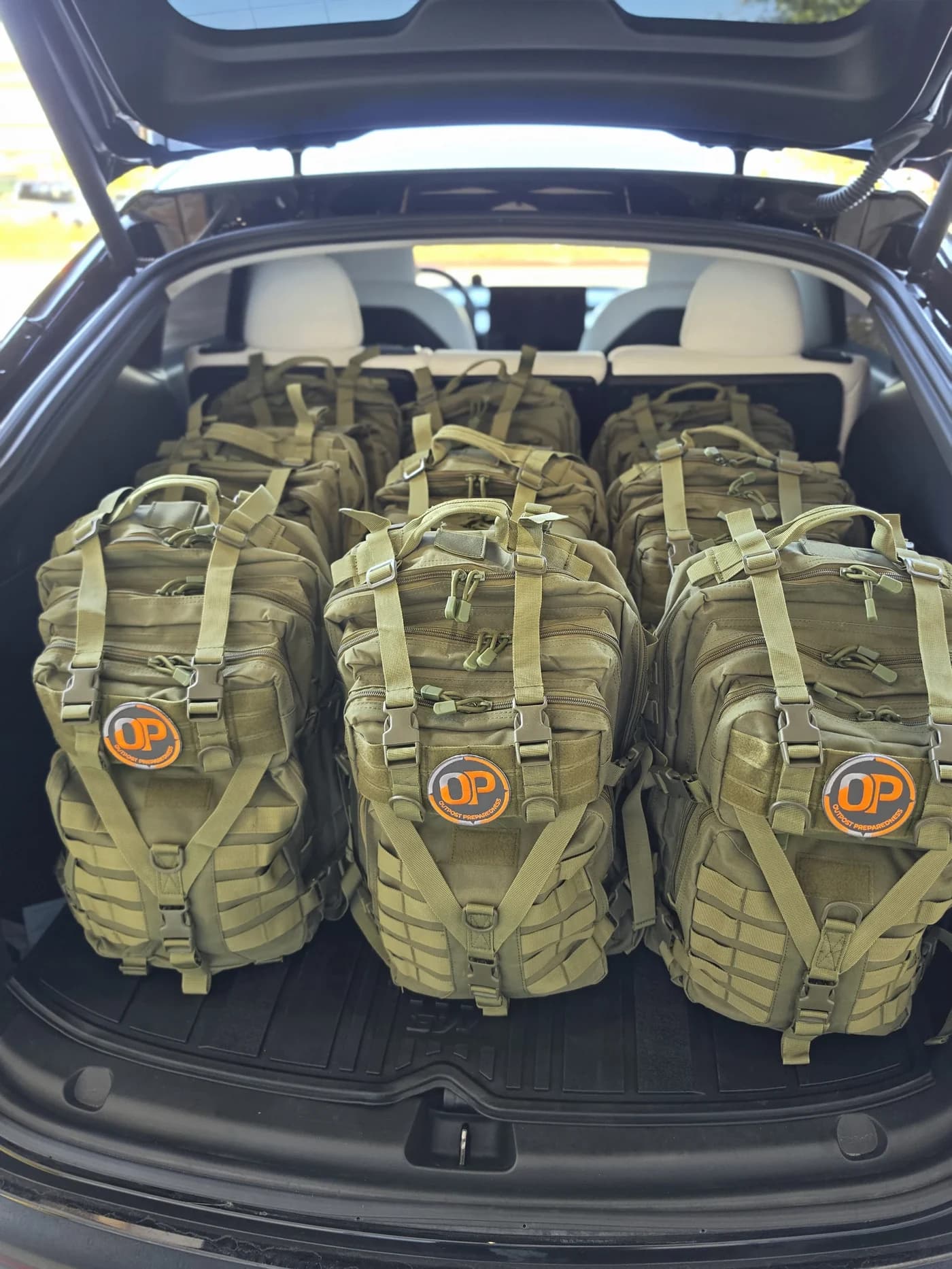
A get-home bag is deliberately smaller than a go-bag because it has a shorter job: cover the distance between where you work and where your people are. Twelve to twenty-four hours, not three days.
The highest-value item in it is not dramatic. It is shoes. The number of people who commute in footwear they could not walk ten miles in is close to everyone, and the walk-home events on record — the 2003 Northeast blackout, the morning of September 11th in Manhattan — were defined by exactly that problem. After shoes: water, a couple of dense calorie bars, a charged battery pack, a flashlight, a dust mask, cash in small bills, and your addresses and phone numbers written on paper, because a dead phone takes your entire contact list with it.
If you work from home, skip this one honestly and put the money in the vehicle kit instead. The point is to fill your gap, not to own the complete set.
The shelter-in-place kit: different physics entirely
Everything above is governed by portability. The shelter-in-place kit is governed by volume, and that single change rewrites the whole list.
Water is the entire game. Ready.gov's guidance is one gallon of water per person per day, for several days, covering both drinking and sanitation. Run the arithmetic before you shop: a household of four planning for one week needs 28 gallons. That is not going in a backpack. That is a corner of the garage, and it is the reason a home supply and a go-bag can never be the same object.
After water, the categories that matter are the ones that fail together when the grid does: light, power for phones and radios, information you can receive without the internet, a way to make hot food without the stove, and sanitation. That last one is the least-planned and the fastest to become a genuine health problem — when the water is off, the toilet stops being a toilet, and the plan needs to already exist.
One correction worth making, because it circulates as general advice: plastic sheeting and duct tape are not all-purpose preparedness items. Sealing a room is a specific procedure for a chemical or airborne release, and it is the wrong response to almost everything else. Do not let it stand in for having water.
The facility kit: when the people are not yours to pack for
This is where households and buildings stop being the same problem. In a home, everyone can pack for themselves. In a school, a terminal, a care community, or an office floor, the people in the building did not pack — and practically, the answer to their first days is the operator's.
The arithmetic is unforgiving: the duration times everyone present, not the duration times the ones who happened to plan ahead. But note the word duration, because at this tier you no longer get to pick 72 hours by habit. A California RCFE has to hold a week of non-perishable food on the premises. A hospital has to have assessed 96 hours. A general workplace is required to have an evacuation plan and is required to stock nothing — which means the supply question there is a decision somebody has to make on purpose, rather than a box a regulator will make them tick.
It also has a sequence, and the sequence is usually the part that gets skipped.
The Kansas Department of Labor did it in an order worth copying. Evacuation chairs and ProMove transfer slings for the people who cannot take the stairs. Training for the staff who would be carrying them. DrewOS to hold the compliance record and flag who needs help before anything happens. And 72-hour kits, because the first three days are the ones you cover yourself.
The question that has to come before any of it: who in this building cannot self-evacuate? A building can be fully stocked with supplies and still fail, because supplies were never the constraint on the third floor. Answer the mobility question first, then the supply question.
What actually goes in a 72-hour kit
Packing lists get long fast, and length is how people end up with a heavy bag full of things they will never use. It is more durable to think in categories, then satisfy each one with the lightest thing that does the job.
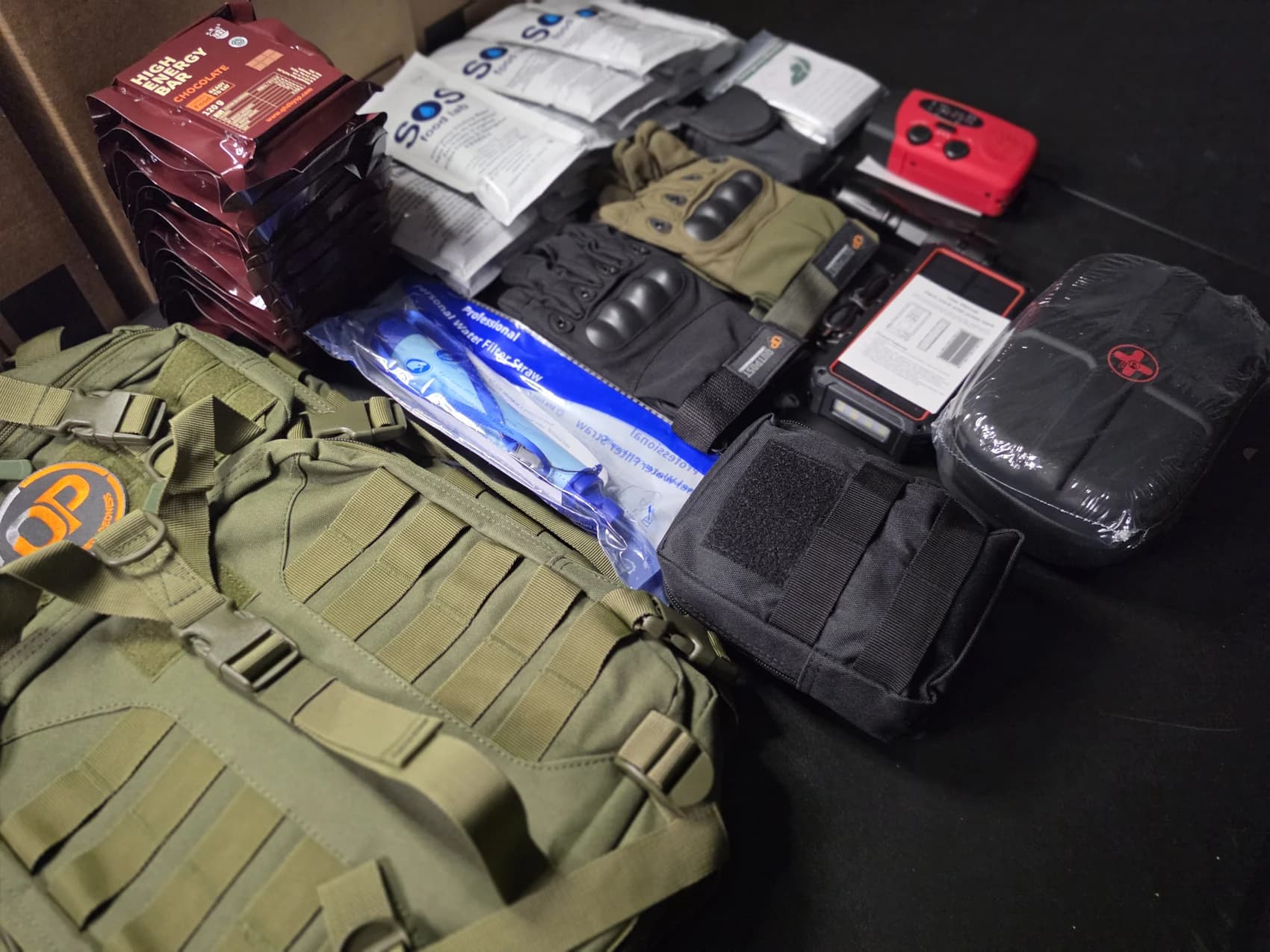
Water and a way to treat more of it. Dense food that needs no cooking. Light. Power. Information you can get without a network — a battery or hand-crank radio still works when the towers are saturated. Medical, including a real supply of any prescription you take. Warmth and dry layers. Gloves. Documents. Cash. Hygiene. A small tool set.
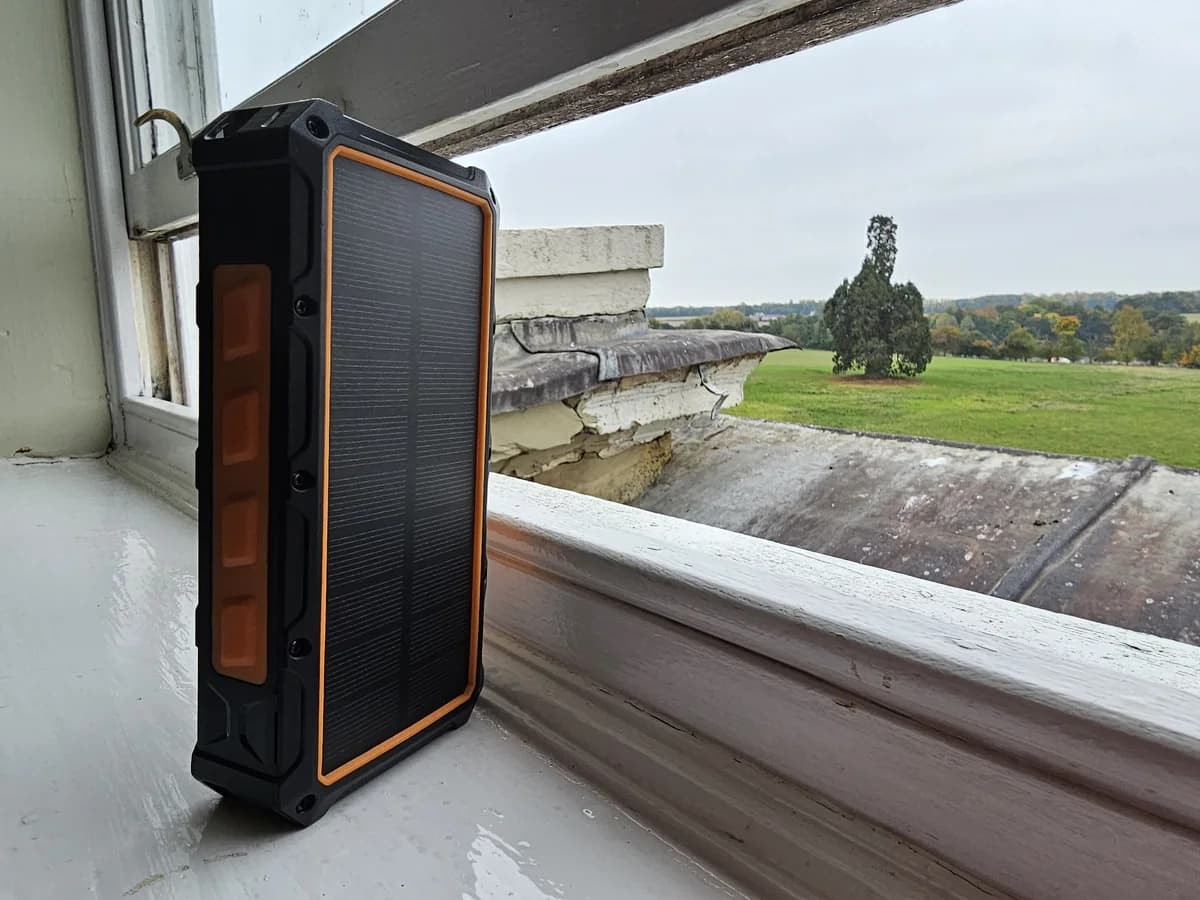
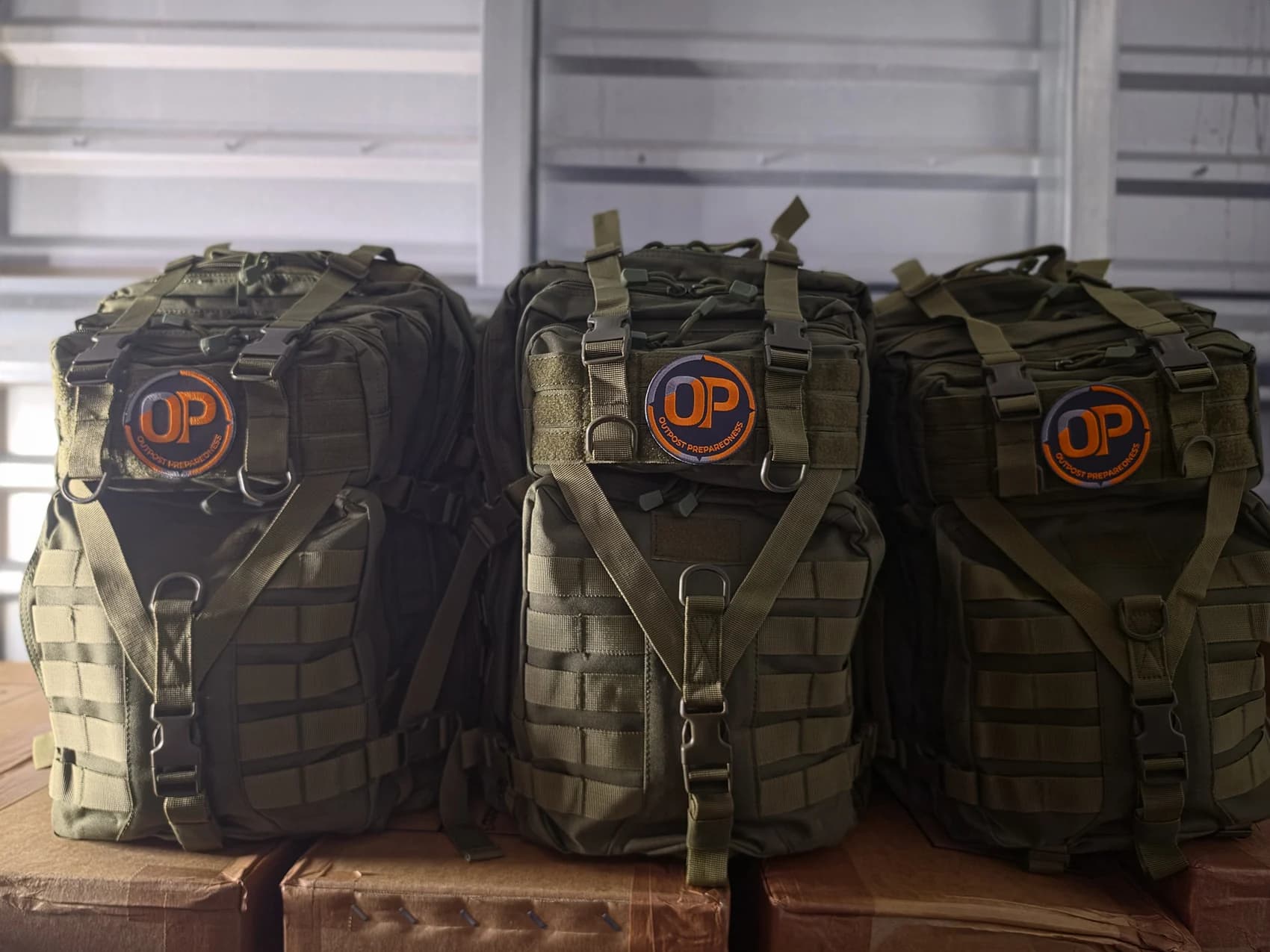
A packed kit of ours runs to gloves, a solar power bank, an emergency radio, water pouches, high-energy bars, a medical kit, a filter straw, and a fire starter — which is a fair picture of what those categories look like once they are made physical and weighed.
The three most-forgotten items are consistent, and none of them are gear. Prescription medication. Copies of documents — insurance, IDs, prescriptions, the deed — on paper and on a thumb drive, because you will be asked to prove things later. And cash in small bills, since card readers are among the first things to go and nobody at a roadside stand can break a hundred.
The mistakes that turn a kit into a decoration
Almost every failed kit fails for one of a short list of reasons, and none of them are about buying the wrong brand.
It is stored somewhere you cannot reach in the dark, in a hurry, with your hands full. It was packed once and never rotated, so the water pouches, the bars, the batteries, and the medication are all past date at the same time. It is too heavy for the person whose name is on it. There is one kit for a family of five. It has never been opened, so the first time anyone tries to work the radio is the worst possible moment to learn. The kids' and the pets' needs are missing entirely. And everything important is digital, on the phone that is now at four percent.
The fix for most of that is a calendar entry, not a purchase. Twice a year — the daylight-saving changes are the easiest anchor anyone remembers — open every kit, check the dates, swap what expired, and re-check that the bag still fits the person. Kids grow out of a go-bag the same way they grow out of shoes.
- ›Tonight: pick the door you actually leave by, and put the go-bag there — with shoes next to it. Placement beats contents.
- ›Do the water arithmetic for your household before buying anything: one gallon per person per day, times the number of days you are planning for.
- ›This week: put a pair of walking shoes at your desk. It is the highest-value item in a get-home bag and it costs nothing new.
- ›Set two recurring calendar reminders at the daylight-saving changes to open every kit, check dates, and re-fit it to the person.
- ›Put documents on paper and on a thumb drive — insurance, IDs, prescriptions, deed — plus cash in small bills. All three get forgotten.
- ›Fill your gap, not the set. If you work from home, skip the get-home bag and put the money in the vehicle kit.
- ›If you are responsible for a building, answer "who here cannot take the stairs?" before you answer "how many kits do we need?"
- ›Look up the duration that actually binds your building before defaulting to 72 hours — a California RCFE owes a week of food, a hospital owes a 96-hour assessment, and a general workplace owes nothing at all.
Questions professionals ask
Yes. Go-bag, bug-out bag, BOB, GOOD bag, grab bag, ready bag, and evacuation bag all describe the same object: a portable kit for one person, grabbed on the way out, sized for roughly 72 hours. The name changes with who is talking — military, prepper, British, or federal — but the contents do not.
There isn't one. "72-hour kit" is a go-bag with the planning duration written into the name. If someone is describing something meaningfully different, they usually mean the home supply, which is larger, stays put, and is not carried.
It is the conventional planning window for how long you may need to be self-sufficient before organized assistance reliably reaches individual households. It is a convention rather than a guarantee — in a large or remote event it can run longer, which is an argument for a home supply that outlasts the bag you carry.
One per person, including children, each sized to what that person can actually carry. A single shared family bag fails the moment the family is not standing in the same room, which on a weekday morning is most of the time.
Ready.gov's guidance is one gallon of water per person per day, for several days, covering drinking and sanitation. A go-bag cannot physically carry that for three days, which is why a carried kit pairs water with a filter or purification method, and why the home supply is stored by the gallon instead.
The go-bag assumes you are leaving, so weight governs everything. The shelter-in-place kit assumes you are staying with the utilities down, so volume governs instead — water, power, sanitation, light, and a way to cook without the stove. Most households need both, and they cannot be the same object.
Beyond the usual water, food, light, and first aid, the vehicle-specific items are jumper cables or a jump pack, a reflective triangle or flares, a tow strap, a real blanket, a 12V charger, and — in cold climates — an ice scraper plus sand or cat litter for traction. Temperature, not hunger, is what harms people in stranded-vehicle incidents.
Probably not. The get-home bag exists to close the distance between your workplace and your family, and if that distance is zero the money is better spent on the vehicle kit or on deepening the home supply. Fill your actual gap rather than collecting the full set.
Twice a year is the practical rhythm, anchored to the daylight-saving changes because they are easy to remember. Check expiry on food, water, batteries, and medication, and re-check that the bag still fits the person carrying it. Vehicle kits need it more often, because heat in a trunk shortens everything's life.
No. It is a widely used convention rather than a published requirement. Ready.gov's household guidance says to be able to survive on your own "for several days" and specifies one gallon of water per person per day — it does not state 72 hours. The durations that are written into rules land elsewhere: 96 hours for hospitals under Joint Commission and CMS, one week of non-perishable food on the premises for California RCFEs, and no supply duration at all for general workplaces under OSHA.
Treat 72 hours as a floor to clear rather than a target to stop at. Several state emergency-management agencies now ask for considerably more — Oregon's "Be 2 Weeks Ready" program asks residents for 14 days of food, water and supplies for every person and pet, on the basis of its own Cascadia earthquake modelling. The practical route is the one Oregon recommends: build the 72-hour bag first, then deepen the home supply toward two weeks over time. The carried bag stays at 72 hours regardless, because weight does not negotiate.
No, and this is the most misread requirement in the category. The Joint Commission and CMS require a hospital to assess its ability to sustain operations for the first 96 hours of an emergency, inventory what it has, identify the shortfalls, and plan how it would mitigate them — including when it would limit services or evacuate. There is no requirement to hold 96 hours of resources or to remain fully functional through them. It is a planning and gap-analysis obligation, not a warehousing one.
No. OSHA's Emergency Action Plan standard, 29 CFR 1910.38, requires procedures for reporting an emergency, evacuation and exit-route assignments, arrangements for employees running critical operations, a method to account for everyone afterward, rescue and medical duties, and a named contact for questions. Supplies, food, and water appear nowhere in it. Any workplace kit is therefore a deliberate decision rather than a compliance obligation — which is exactly why so many buildings have an evacuation plan and nothing to hand the people it evacuates.
If the people in your building did not pack for themselves — students, residents, passengers, staff — then their first days are the operator's problem, and the arithmetic is the duration times everyone present. Check which duration actually binds you before defaulting to 72 hours: California RCFEs must keep a week of non-perishable food on site, hospitals must have assessed 96 hours, and general workplaces have no supply requirement at all. Sequence matters too: settle how you will move the people who cannot use the stairs before you settle how many kits to buy, because supplies were never the constraint on the upper floors.
- Ready.gov — Build A Kit
- Ready.gov — Water
- Ready.gov — Food
- Ready.gov — Car Safety
- Ready.gov — Shelter
- Oregon Dept. of Emergency Management — Be 2 Weeks Ready
- The Joint Commission — Emergency Readiness (96-hour planning)
- Health Facilities Management — Learning the truth about the 96-hour rule
- Cal. Code Regs. tit. 22 § 87555 — RCFE food service requirements
- OSHA 29 CFR 1910.38 — Emergency Action Plans
- American Red Cross — Survival Kit Supplies
We write these guides so you can act on them without buying anything. Everything here is drawn from public federal preparedness guidance and from packing these kits ourselves. Last updated August 31, 2026.
We build these kits ourselves — packed, sealed, and dated, so the only decision left is where it lives.